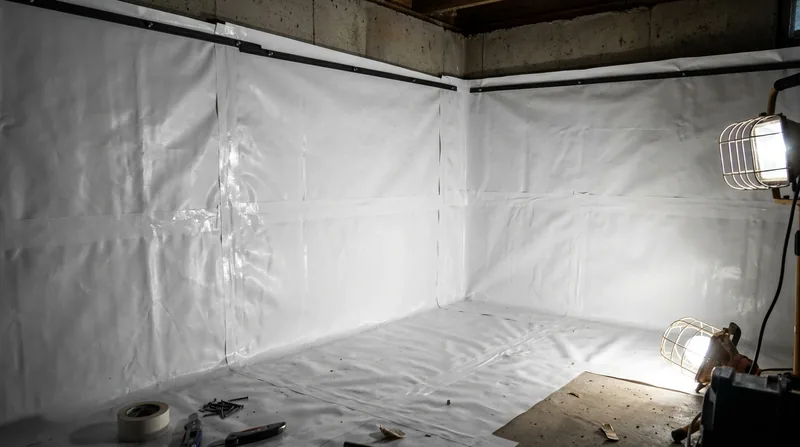




Vapor Barrier Installation in Burlington solves a problem that starts below your feet, not at your walls. This city sits on deep Champlain Sea clay that holds groundwater like a sponge, and the record lake level of spring 2011 plus the Winooski River floods of Irene and July 2023 pushed that water table up into thousands of full basements. In the Hill Section and around the university, 1840s to 1910s stone and brick foundations wick ground moisture straight into the mortar. In the Old North End and South End worker homes, the same thing shows up as white efflorescence and a musty smell that never quite leaves. We install heavy-duty vapor barrier sheets on basement walls and across the slab, seal the seams, tape the terminations, and tie the system into your sump where the layout calls for it. If you are already fighting a wet basement, start with our basement waterproofing service and we will tell you honestly whether a barrier alone is enough.
Why Burlington Basements Stay Damp Even When the Sump Pump Runs
Most damp basements here are not flooding. They are breathing. The clay under the New North End and South Burlington block foundations holds water against the footing, and that moisture moves through concrete and mortar as vapor, not as a puddle. You get a clammy lower level, rusted fasteners, and efflorescence on the wall long before you ever see standing water. A vapor barrier addresses that movement directly instead of waiting for it to become a leak.
- Champlain Sea clay drains very poorly, so hydrostatic pressure stays on the wall through wet springs and long thaws.
- Stone and brick foundations in the Hill Section and Old North End pull ground moisture through mortar joints that were never meant to be waterproof.
- Damp marine clay under slab-on-grade additions keeps the floor cold and releases vapor upward all summer.
- Freeze-thaw cycles open hairline cracks that let vapor through even when the wall looks solid.
- Downspouts that dump next to the foundation recharge the soil and undo any wall coating within a season.
A barrier does not replace drainage, but it stops the vapor side of the problem that drainage alone never fixes.
Key info: A 1920s duplex off North Avenue had visible dampness on every wall but no standing water. The footing drain was working. The moisture was vapor coming through the block, and a sealed wall barrier plus taped slab sheet dried the lower level without any excavation.
For the code and permit side of any basement work in the city, the City of Burlington building department is the authority to check with before you schedule.
How We Install a Vapor Barrier in a Burlington Basement
We start with a free basement inspection because the barrier spec depends on what the wall is actually doing. A poured wall in a 1990s Essex Colonial gets a different sheet and seam layout than a rubble stone foundation near the university. Before any plastic goes up, we confirm whether the wall is dry enough to seal or whether it needs crack repair or drainage first. Then we build the barrier to stay sealed for years, not to look tidy on install day.
- We inspect the walls, slab, and footing drain and check for active seepage, efflorescence, and bowing.
- We correct what has to be corrected first, including crack injection or a foundation crack repair where water is entering through the wall itself.
- We clean and parge rough stone or brick so the sheet sits flat and the adhesive or fasteners hold.
- We hang heavy-duty barrier sheets with overlapping seams and seal every seam with the manufacturer's tape.
- We tape terminations at the rim, the slab, and around penetrations so vapor cannot bypass the sheet.
- We integrate the barrier with the sump basin and discharge where the layout requires it.
- We leave you with a walkthrough of what was sealed and what to watch for next spring.
The result is a lower level that stays dry to the touch and stops feeding moisture into the air every time the clay below gets saturated.
Key info: On a 1950s ranch in South Burlington, the slab sheet had to tie into a sump basin that ran during every spring melt. We sealed the sheet to the basin rim and taped the discharge penetration so the pump could keep working without pulling vapor through the new barrier.
If your inspection shows water entering at the wall base rather than as vapor, the better answer is usually an interior drain tile system, and we will say so plainly.
Vapor Barrier Options We Use in Burlington Homes
Not every basement needs the same sheet. A damp but dry wall in a Winooski mill house and a sweating slab in a 2010s Williston Colonial call for different products and different seam strategies. The table below shows the approaches we specify most often and where each one fits.
| Approach | Description | Best for |
|---|---|---|
| Wall sheet barrier | Heavy-duty sheet hung on the wall with sealed overlaps and taped top and bottom terminations. | Block and poured walls with vapor movement but no active seepage. |
| Slab barrier | Sheet laid over the slab and sealed at the cove joint and penetrations. | Damp floors over Champlain Sea clay, common in the New North End. |
| Dimple board drainage plane | Drainage mat that lets water fall to the base while keeping the wall dry. | Stone and brick walls in the Hill Section with rough parging. |
| Barrier with sump integration | Sheet tied to the sump basin rim and discharge penetration with sealed boots. | Basements with an active pump and a wet spring melt. |
We choose the sheet and the seam layout only after we see the wall, because the wrong product on a rough stone foundation will peel within a season.
Vapor Barrier Installation Cost in Burlington: What to Expect
Most wall and slab barrier work in Burlington starts from $3 per square foot, and that figure is a starting point rather than a flat rate. The number moves with wall condition, access, and how much prep the surface needs before a sheet will hold. A clean poured wall in a Shelburne Colonial is a faster job than a rubble stone foundation near the university that needs parging first.
- Wall material matters: rough stone and brick need prep that poured concrete does not.
- Square footage of wall and slab drives the sheet and tape quantity directly.
- Access affects labor, especially in tight Old North End basements with low headroom.
- Sump integration adds fittings and time when the barrier has to seal around a basin.
- Active seepage changes the scope, because crack repair or drainage may come before the sheet.
Get two or three estimates and compare what each one actually includes, because a low number that skips prep is not the same job. Our full pricing overview lays out how we build a number.
Choosing a Waterproofing Contractor Near Me in Burlington
You want a contractor who has worked on your kind of foundation, not a general handyman with a roll of plastic. Ask what they will do about prep, how they seal seams, and whether they will tell you when a barrier is the wrong answer. A specialist who works below grade every week will give you a straight answer on that.
- Confirm the company is licensed and insured and ask for a certificate before work starts.
- Get multiple written estimates and compare scope, not just the total.
- Ask for references from basements similar to yours, ideally in Chittenden County.
- Check whether a permit is required for any related structural or drainage work with the city building department.
- Ask how they handle a sump discharge connection, since that can fall under plumbing rules.
We are a Basement Health Association member and we work below grade only, so the advice you get is not filtered through a general repair business. Reach out through our contact page to set up a free inspection.
Vapor Barrier Installation in Burlington: Pricing Guide
| Service | Price | Details |
|---|---|---|
| Wall vapor barrier | Starting at $3/sq ft | Includes sheet, seam tape, and terminations; wall condition and prep drive the rate up. |
| Slab vapor barrier | Starting at $3/sq ft | Includes sheet, cove joint sealing, and penetration boots; floor prep and access affect price. |
| Barrier with sump integration | On estimate | Needs an on-site look at the basin rim, discharge routing, and pump setup before pricing. |
| Travel | Included | in Burlington and surrounding areas, no separate call-out or mileage fee |
| Estimate | Free | Response within 24h at (802) 213-8825, no obligation to book |
Indicative pricing, the exact cost depends on square footage, finish, and site access. Free personalized estimate within 24h at (802) 213-8825.


