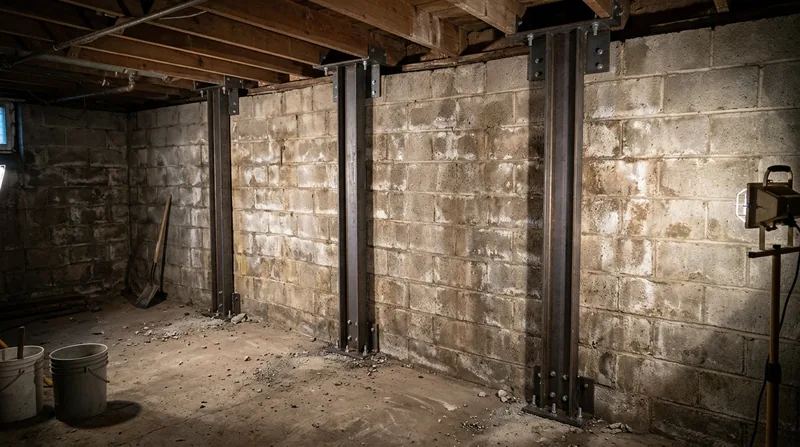




Bowing Wall Repair in Burlington
Burlington's building stock sits on some of the most demanding ground in Vermont. The Hill Section's Greek Revival and Italianate homes rest on stone and brick foundations, the Old North End's worker duplexes sit on full basements dug into Champlain Sea clay, and the New North End's post-war ranches use block walls that have been pushed for seventy winters. When saturated glacial clay soil and deep frost load a wall from the outside, it starts to bow inward. Bowing Wall Repair in Burlington is the work of stopping that movement and bringing the wall back under control before it fails. We stabilize bowing walls with carbon fiber straps, steel I-beams, or wall anchors, matched to how far the wall has moved and what your soil is doing. Call (802) 213-8825 to schedule a free inspection, or start with our free basement inspection.
Why Bowing Walls Are So Common in Burlington's Clay and Frost
Champlain Sea clay drains very poorly. Water that collects behind a foundation wall does not move down and away, so it builds hydrostatic pressure against the block or brick. Add the spring melt, the freeze-thaw cycle, and heavy snow load, and a wall that was plumb in 1950 can be leaning an inch or more by now. The damage shows up first as stair-step cracking at the corners and horizontal cracks at mid-height.
- Horizontal cracks in the middle third of a block wall signal pressure from saturated soil, not a settling problem.
- Stair-step cracking near the corners follows the mortar joints as the wall rotates inward.
- Doors and windows that stick on the basement level mean the wall has moved enough to rack the frame.
- White efflorescence and damp patches at the base point to water pushing through the wall from outside.
- A visible lean at the top plate is late-stage movement and needs bracing, not sealing.
If you see any of these, the wall is telling you the soil is winning. The fix is structural, and it should not wait another season.
Key info: In the Old North End and along the Winooski River valley, we routinely find block walls bowing after the spring melt. The July 2023 flooding and the 2011 Irene event both saturated soils that never fully drained, and walls that were already stressed moved further. Structural repair permits are commonly required for this work, and the City of Burlington's building department is the authority to verify requirements with.
How We Diagnose and Stabilize a Bowing Wall in Burlington
We start by measuring the movement, not guessing at it. A plumb line and a level tell us how far the wall has traveled and where the pivot point is. Then we look at the soil side: grading, downspout discharge, and whether the footing drain is still functioning or has silted shut. The repair method follows from that diagnosis, and we tell you plainly when a wall only needs monitoring.
- We inspect the full wall and record crack widths, lean, and any displacement at the sill plate.
- We check the exterior grade and drainage so the soil pressure source gets addressed, not just the symptom.
- We recommend carbon fiber straps for hairline to moderate movement, steel I-beams for deeper bowing, and wall anchors where the wall must be pulled back.
- We pull the permit through the City of Burlington when structural work requires it, and we schedule the install around your basement use.
- We seal any active cracks with epoxy or polyurethane injection after the wall is stabilized, so water and air stop moving through.
Every repair ends with a written record of the movement so you can track it over time.
Key info: A 1950s ranch in the New North End had a block wall bowing two inches at mid-height after years of roof water dumping at the foundation. We installed five carbon fiber straps, extended the downspouts, and re-graded the soil. The wall has held stable through three spring melts. For the drainage side of that work, see our exterior basement waterproofing page.
Bowing Wall Repair Methods We Use
The right method depends on how far the wall has moved, what the wall is made of, and how much room you have on the exterior. Carbon fiber is the least invasive option for block walls with moderate movement. Steel I-beams handle deeper bowing and heavier soil loads. Wall anchors are the choice when the wall needs to be pulled back toward plumb rather than just held in place.
| Approach | Description | Best for |
|---|---|---|
| Carbon fiber straps | High-strength straps bonded vertically to the wall and anchored at the floor and sill. | Block walls with hairline to moderate bowing and no exterior access. |
| Steel I-beams | Vertical steel beams set against the wall and tied into the floor system. | Deeper bowing, heavier clay loads, and walls that need rigid support. |
| Wall anchors | Anchor plates set in the exterior soil and connected through the wall to interior plates. | Walls that must be pulled back toward plumb over time. |
| Epoxy or polyurethane injection | Crack sealing after stabilization to stop water and air movement. | Active cracks in a wall that has already been braced. |
We match the method to the measurement, and we tell you when a wall only needs monitoring rather than repair.
Bowing Wall Repair Cost in Burlington: What to Expect
Pricing starts at $600 for crack injection and minor stabilization work. A full carbon fiber strap installation on a typical block wall runs considerably higher, and wall anchors or steel I-beams sit above that. The variables that move the number are the length of wall affected, how far it has bowed, whether the exterior soil needs work, and access to the wall inside the basement.
Homes in the Hill Section with stone and brick foundations often need more prep than a poured-concrete basement in Essex, and that shows up in the estimate. Getting two or three written estimates is smart, and any contractor who quotes a structural repair without measuring the wall is guessing. Our pricing overview lays out the ranges so you can compare bids fairly.
How to Choose a Bowing Wall Repair Contractor Near Me in Burlington
Structural repair is not a job for a general handyman. Ask for proof of licensure and insurance, and confirm the company carries both general liability and workers' compensation. Ask how they measure wall movement and whether they pull permits through the City of Burlington when the scope requires it. Check references from jobs in Chittenden County, not just testimonials on a website.
If your home is in a historic district or an HOA, confirm any exterior work requirements before signing. A contractor who cannot explain the difference between carbon fiber and wall anchors, or who promises a lifetime warranty, is one to pass on. We offer a transferable warranty and put the scope in writing. Reach out through our contact page to set up an inspection.
Bowing Wall Repair in Burlington: Pricing Guide
| Service | Price | Details |
|---|---|---|
| Crack injection and minor stabilization | Starting at $600 | Epoxy or polyurethane injection with ports, plus monitoring of a wall with limited movement. |
| Carbon fiber strap installation | On estimate | Number of straps, wall length, and access inside the basement drive the final price. |
| Steel I-beam or wall anchor system | On estimate | Severity of bowing, soil load, and exterior access determine the scope and cost. |
| Travel | Included | in Burlington and surrounding Chittenden County areas, no separate call-out or mileage fee |
| Estimate | Free | Response within 24h at (802) 213-8825, no obligation to book |
Indicative pricing, the exact cost depends on square footage, finish, and site access. Free personalized estimate within 24h at (802) 213-8825.


