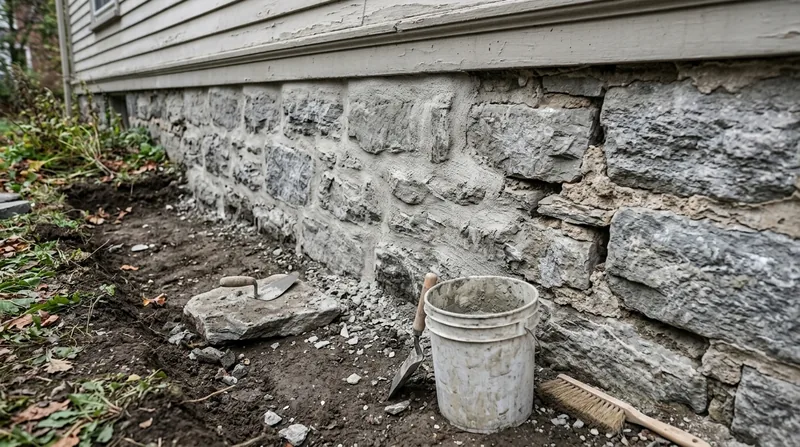




Burlington sits on a slope that runs from the Lake Champlain shore up past the university, and that geography decides how your foundation behaves. The Hill Section and the streets near UVM carry 1840s to 1910s Greek Revival, Italianate and Queen Anne homes on stone and brick foundations that were never meant to hold back a modern water table. The Old North End's 1880s to 1930s worker homes and duplexes sit on full basements in dense Champlain Sea clay that drains about as well as a clay pot. Foundation Waterproofing in Burlington means reading that specific ground before we touch a wall, because a seeping stone foundation near the lake and a poured-concrete basement in Essex fail for completely different reasons.
We work below grade only: stone, brick, block and poured concrete. We repoint old stone with compatible lime mortar instead of trapping it under a hard cement skin, we inject cracks, and we correct the drainage that put the water there in the first place. If you are still sorting out whether the problem is a crack or pressure from saturated clay, start with a free basement inspection and we will tell you plainly which one it is.
Why Burlington Foundations Take On Water: Clay, Frost and a Rising Lake
Most wet basements here trace back to the ground, not the concrete. Champlain Sea clay holds water against the wall until hydrostatic pressure finds the weakest point: a mortar joint in a Hill Section stone foundation, the cove joint where a New North End block wall meets the footing, or a hairline shrinkage crack in a 1990s Williston pour. Add deep frost, a heavy spring melt and hard freeze-thaw cycles, and the soil moves enough to open old repairs year after year.
- Record lake levels in spring 2011 pushed the water table up through lakeshore ground and into basements that had stayed dry for decades.
- The Winooski River valley flooded during Tropical Storm Irene in 2011 and again in July 2023, saturating lowland soils across Winooski and the Intervale side of Burlington.
- Old stone and brick foundations in the Old North End wick moisture upward, which shows as white efflorescence and a musty basement smell long before you see standing water.
- 1940s to 1970s Capes and ranches in South Burlington sit on block basements with aging footing drains that silt up and stop carrying water away.
- Homes under mature maples, white pines and birches deal with root systems that clog weeping tile and shift shallow footings.
None of that is solved by painting a sealer on the inside face of the wall, and we will say so on the first visit.
Key info: A brick foundation in the Hill Section and a poured wall in Shelburne rarely need the same fix. Brick and stone need to breathe, so we use lime-based repointing and vapor-permeable treatments, while poured concrete can take crystalline or membrane systems. Getting that match wrong traps moisture and accelerates spalling.
Permits for structural foundation repair and for work that alters drainage or the sanitary connection of a sump discharge vary by jurisdiction, so confirm the current rules with the City of Burlington Department of Public Works or your town's building department before work starts. The City of Burlington publishes permit guidance for homeowners.
How We Diagnose and Waterproof a Burlington Foundation
We start by finding where the water actually enters, not where the stain is. That means checking grade and downspout extension, reading the wall for efflorescence and vertical vs diagonal cracking, probing the drain tile at the sump basin, and confirming whether the sump pump and check valve are doing their job. Only then do we choose between a targeted crack repair and a full drainage correction.
- We walk the exterior first, checking grading, downspout discharge and window well drainage, because a two-foot grade correction sometimes solves a wet basement outright.
- We inspect the interior perimeter for the cove joint, wall seepage, efflorescence and any sign of hydrostatic pressure pushing water through the block cores.
- We test the existing footing drain and sump pump, and we tell you if the pump is fine and the drain tile is the real failure.
- We recommend the narrowest fix that works: epoxy or polyurethane injection for an active crack, repointing with lime mortar on old stone, or an interior perimeter drain when pressure is the driver.
- We correct the discharge, extending downspouts and grading away from the wall so the water leaves the footprint.
Every recommendation comes with the reasoning behind it, so you can compare it against another contractor's proposal line by line.
Key info: A South End home near the lake had water after every heavy rain and a sump pump that ran constantly. The wall itself was sound. The footing drain was silted solid and the downspouts dumped at the foundation. We replaced the drain tile, added an interior perimeter drain to a new sump basin, and extended the discharge, and the pump went back to cycling only in real storms. Excavating the exterior would have cost far more for the same result.
When the wall is bowing rather than seeping, the answer is structural, and we handle that under bowing wall repair with carbon fiber straps or wall anchors.
Waterproofing Methods We Use on Burlington Foundations
The right approach depends on the foundation material, the water source and how much access the site allows. Here is how the main options compare for Chittenden County homes.
| Approach | Description | Best for |
|---|---|---|
| Epoxy injection | Ports set along the crack, resin injected to fill and bond the full depth. | Non-moving poured-concrete shrinkage and settlement cracks. |
| Polyurethane injection | Flexible foam expands and stays sealed when the wall moves. | Active leaks and cracks that open and close with freeze-thaw. |
| Lime repointing and parging | Soft lime mortar packed into joints, breathable finish over the face. | Hill Section and Old North End stone and brick foundations. |
| Interior perimeter drain | Drain tile set at the footing inside, leading to a sump basin and pump. | Hydrostatic pressure and failed footing drains with limited exterior access. |
| Exterior membrane and dimple board | Waterproof membrane on the wall face, dimple board and drain tile at the footing. | Full excavation where the wall face is the main entry point. |
We will tell you when simple crack sealing is enough and when the real problem is pressure that no sealer will hold back.
Foundation Waterproofing Cost in Burlington: What to Expect
Most foundation waterproofing work here starts around $3,500, and that figure usually covers a defined scope such as crack injection, repointing a failing section of stone, or a targeted drainage correction. Larger jobs move up from there, and the drivers are concrete: how much wall is affected, whether we are cutting a floor for an interior drain, how tight the access is on a Hill Section lot where the house sits close to the property line, and whether the discharge has to be reworked.
Old stone foundations take more labor than a poured wall because the joints are irregular and the mortar has to match. A full interior perimeter drain with a sump basin and discharge line sits well above the starting figure, and exterior excavation with membrane and dimple board is the highest-scope option. Get two or three written estimates and compare the scope line by line, not just the total. Our full pricing overview breaks down how each scope is built.
Finding Foundation Waterproofing Near Me in Burlington: What to Check
Any contractor can hand you a brochure. The questions that matter are boring and practical. Ask for proof of licensing and insurance before anyone touches your foundation, and get a certificate of coverage sent to you directly rather than a photocopy. Ask how many stone foundations they have repointed in the Old North End, because lime mortar work is a different skill from pouring concrete.
Get at least two estimates, ask for references from jobs in Burlington or South Burlington, and confirm who pulls the permit if structural repair or drainage alteration is involved. On shared or historic properties, check any local review requirements before scheduling. You can contact us for a free estimate and we will walk the basement with you.
We are a Basement Health Association member, and we specialize in below-grade work rather than general foundation repair or plumbing.
Foundation Waterproofing in Burlington: Pricing Guide
| Service | Price | Details |
|---|---|---|
| Crack injection (epoxy or polyurethane) | Starting at $3,500 | Covers port setup, resin injection and sealing on a defined crack; active leaks move the price up. |
| Stone or brick repointing and parging | Starting at $4,200 | Lime mortar repointing and breathable finish; irregular 1800s joints and large wall areas raise labor. |
| Interior perimeter drain with sump basin | Starting at $8,500 | Floor cutting, drain tile, sump basin and pump; basement finish and access drive the total. |
| Exterior membrane with dimple board | On estimate | Full excavation, membrane and footing drain; tight Hill Section lots need an on-site look first. |
| Travel | Included | In Burlington and surrounding Chittenden County towns, with no separate call-out or mileage fee. |
| Estimate | Free | Response within 24 hours at (802) 213-8825, with no obligation to book the work. |
Indicative pricing, the exact cost depends on square footage, finish, and site access. Free personalized estimate within 24h at (802) 213-8825.


