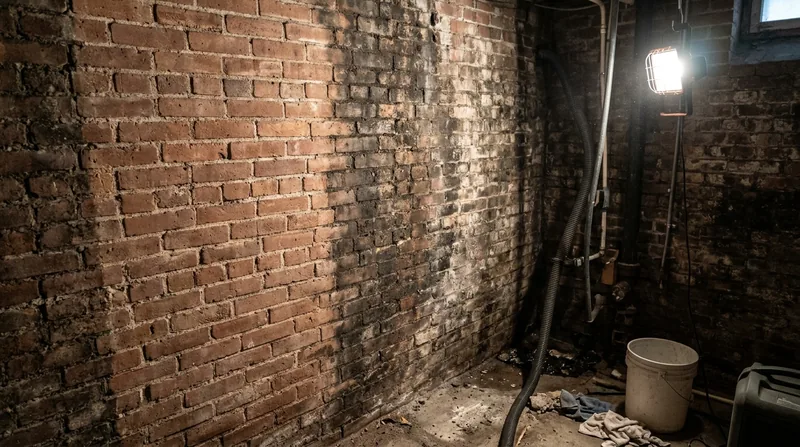




Basement Mold Remediation in Burlington: Fix the Moisture, Then the Mold
Basement mold remediation in Burlington starts with a simple truth field crews learn fast: mold is a symptom, not the problem. The problem is water, and this city has plenty of it. Burlington climbs from the Lake Champlain shore up to the university, and the ground changes block by block. The Hill Section sits on dense Champlain Sea clay that drains poorly. The Old North End has 1880s-1930s worker homes and duplexes on full basements that have been damp for a century. The New North End and South Burlington run on 1940s-1970s Capes with block basements, and Essex, Williston, and Shelburne have poured-concrete basements from the 1980s forward.
We treat the affected surfaces, contain the work area, and then fix the moisture source so the growth does not come back next spring. If you already see basement waterproofing as the bigger picture, that is usually the right instinct. Call (802) 213-8825 to schedule a free basement inspection.
Why Basement Mold Grows So Fast in Burlington Homes
Burlington gets heavy snow, deep frost, a big spring melt, and hard freeze-thaw cycles. That combination pushes water against foundations in waves. The Champlain Sea clay under much of the city holds moisture instead of draining it, so hydrostatic pressure builds against stone and brick foundations that were never designed for it. Lakeshore ground rose to a record lake level in spring 2011, and the Winooski River valley flooded during Tropical Storm Irene in 2011 and again in July 2023. Add humid summers and unvented damp basements, and mold has everything it needs.
- Stone and brick foundations in the Hill Section wick groundwater and stay damp long after a storm passes.
- Old North End full basements often have no vapor barrier, so summer humidity condenses on cool masonry.
- Block basements in the New North End and South Burlington crack at the mortar joints and let water seep through.
- Sump pump failures during spring melt leave standing water that feeds mold within days.
- Improper grading and short downspouts dump roof water right against the foundation.
Each of these is a moisture problem first. We diagnose which one you have before we treat anything.
Key info: A home near the Winooski River in Burlington's Old North End showed mold along the bottom two feet of a stone wall after the July 2023 flood. The wall was still damp six weeks later because the footing drain was silted shut. Treating the mold without clearing that drain would have wasted the homeowner's money.
For official guidance on moisture and mold in buildings, the U.S. Environmental Protection Agency publishes a useful reference at epa.gov/mold.
How We Run Basement Mold Remediation in Burlington
We work in a fixed order: find the moisture, contain the area, remove the growth, then correct the source. Skipping the last step is why mold returns. A musty smell diagnostic comes first, because smell tells us where water is hiding behind parging or under a failed vapor barrier. From there we build the scope around what the basement actually needs.
- We inspect the foundation, drain tile, sump basin, and grading to locate every moisture entry point.
- We set up containment with poly sheeting and negative air pressure so spores do not spread through the house.
- We remove mold from joists, walls, and stored materials, and dispose of porous items that cannot be saved.
- We treat affected surfaces with an antimicrobial and HEPA-vacuum the entire work area.
- We correct the source with drainage, sealing, a vapor barrier, or dehumidification as the diagnosis dictates.
- We verify moisture readings are stable before we close out the job.
The source correction is where the real work lives, and it is why we do not quote remediation as a standalone line item without an inspection.
Key info: A 1920s duplex near the university in Burlington had mold across the ceiling joists from condensation, not seepage. The fix was a vapor barrier and controlled dehumidification, not excavation. Diagnosis changes the entire scope.
Remediation and Moisture-Control Approaches We Use
Not every basement gets the same treatment. The table below shows how we match the approach to the moisture pattern we find during inspection.
| Approach | Description | Best for |
|---|---|---|
| Surface treatment and HEPA cleanup | Containment, antimicrobial treatment, and HEPA vacuuming of affected surfaces | Light growth on joists and walls with a known, fixable source |
| Drainage correction | Interior perimeter drain, sump basin, and discharge line to move water away | Recurring seepage and hydrostatic pressure in clay soil |
| Vapor barrier and dehumidification | Sealed vapor barrier plus controlled humidity to stop condensation | Damp older basements with humid summers and no barrier |
| Crack injection and wall sealing | Epoxy or polyurethane injection and sealing at active seepage points | Isolated cracks in poured-concrete basements |
| Full remediation with material removal | Removal of unsalvageable porous materials plus source correction | Long-standing growth after a flood or pump failure |
We recommend the lightest approach that solves the moisture problem, and we tell you plainly when a simple fix is enough.
Basement Mold Remediation Cost in Burlington: What to Expect
Most remediation projects in Burlington start around $1,500 for a contained work area with a clear moisture source. From there, the number moves with square footage affected, how much material has to come out, and what source correction the basement needs. A single damp wall in a South End home is a different job than a flooded Old North End basement with saturated joists and a dead sump pump.
Access matters too. Stone foundations with irregular parging take longer to treat than poured concrete. If the fix requires an interior drain tile system or a sump replacement, that work carries its own cost. We give you a written scope that separates remediation from source correction so you can see exactly what you are paying for.
Get two or three estimates and compare scope, not just price. A low number that skips source correction is not a bargain. Our pricing overview lays out typical ranges.
Basement Mold Remediation Near Me: How to Choose a Contractor Near Burlington
Ask three questions before you sign anything. Is the company licensed and insured, and can they show you a certificate? Will they put the moisture diagnosis and the source correction in writing? And do they carry credentials in below-grade work, such as Basement Health Association membership? A general handyman can wipe a wall. Fixing the reason it grew is a specialist's job.
- Verify licensing and insurance, and request a certificate before work begins.
- Get multiple written estimates with the same scope so you can compare fairly.
- Ask for local references, especially homes with foundations like yours.
- Confirm who pulls any permit required for structural or drainage work, and verify the rules with the City of Burlington building department.
- Never accept a quote that treats mold without addressing the water source.
If a contractor cannot explain where the moisture comes from, keep looking.
Ready to start? Contact us for a free basement inspection, or call (802) 213-8825.
Basement Mold Remediation in Burlington: Pricing Guide
| Service | Price | Details |
|---|---|---|
| Contained remediation, small area | Starting at $1,500 | Includes containment, antimicrobial treatment, and HEPA cleanup for one affected area |
| Remediation with drainage correction | Starting at $3,200 | Adds interior drain tile or sump work; scope and foundation type move the price |
| Full basement remediation after flooding | On estimate | Saturated joists, material removal, and source correction need an on-site look first |
| Travel | Included | in Burlington and surrounding areas, no separate call-out or mileage fee |
| Estimate | Free | Response within 24h at (802) 213-8825, no obligation to book |
Indicative pricing, the exact cost depends on square footage, finish, and site access. Free personalized estimate within 24h at (802) 213-8825.


